Posts

Transformed Afroasiatic N-stems Characterize Egyptian through Coptic: Seven Takeaways from the New Paradigm

Image
[6/29/2026 -  N.B. - some  material from this blogpost has now appeared in the peer-reviewed article of David Mihalyfy,  “Four Newly-Identified N + S-Stem Verbs in the Tale of the Eloquent Peasant and the London-Leiden Magical Papyrus,” Journal of the Society for the Study of Egyptian Antiquities 51 (2024-2025): 59-70.] The following is adapted from a longer article draft that has been undergoing peer review since August 2023, and which is available by request. Research beginning to think through this new paradigm was presented at the Egyptological Conference in Copenhagen and at a Symposium of the American Research Center in Egypt - Missouri Chapter. Some related research can also be found in the most recent issue of the Journal of the Society for the Study of Egyptian Antiquities (Mihalyfy 2022-2023a and Mihalyfy 2022-2023b).  . . . The standard scholarly narrative (e.g. Loprieno 1995: 54, 72-73) says that Afroasiatic N-stems were hardly if ever productive in ...
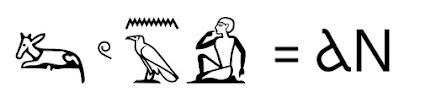
The Origin of the Later Egyptian Negative Particle iwn3 ~ in ~ AN as a Minimizer “Piece”: A Jespersen’s Cycle Etymology Also Relevant to Scholars of Arabic and Berber

Image
  [9/15/2026 -  N.B. - this material has now appeared in more-developed form in  the #OpenAccess, peer-reviewed Prague Egyptological Studies article “ The origin of the Later Egyptian discontinuous negative particle iwnA ~ in ~ AN as a reanalyzed lexical reinforcer 'piece ' ," which should be cited instead of this blogpost.]    The following is adapted from a fuller article draft that began peer review in Fall 2023, and is available from the author by request. Rendered in group (syllabic) writing as the sequence transliterated iwn3 , in Demotic script as the sequence transliterated in , and in Coptic script as ⲀⲚ an , the Later Egyptian discontinuous negative particle has proven to be surprisingly, frustratingly opaque in its origin. For over a century (Gardiner 1904), it has been insightfully and properly compared to structures like the French ne… pas , especially through the Coptic-script sequence ( Ⲛ︦ )… ⲀⲚ ( n) … an : as with the French, this negativ...